A compassionate, clinic-informed plan to reduce separation anxiety in dogs, from prep work and safe set-ups to desensitization sessions and troubleshooting.
When I was a veterinary technician, I saw two kinds of crate training heartbreak on a weekly basis: exhausted people convinced they were “failing” because their puppy cried at night, and anxious puppies who learned the crate meant isolation and panic because it only appeared when someone was frustrated. The crate itself is not the problem. The timing, setup, and habits around it are what make it either a safe den or a tiny stress box.
My goal here is simple: help you create a crate routine that feels calm and predictable for your puppy and sustainable for you. No guilt. No tough-love speeches. Just a clear, practical path from “new crate in the living room” to “my puppy can nap peacefully and settle at night.”
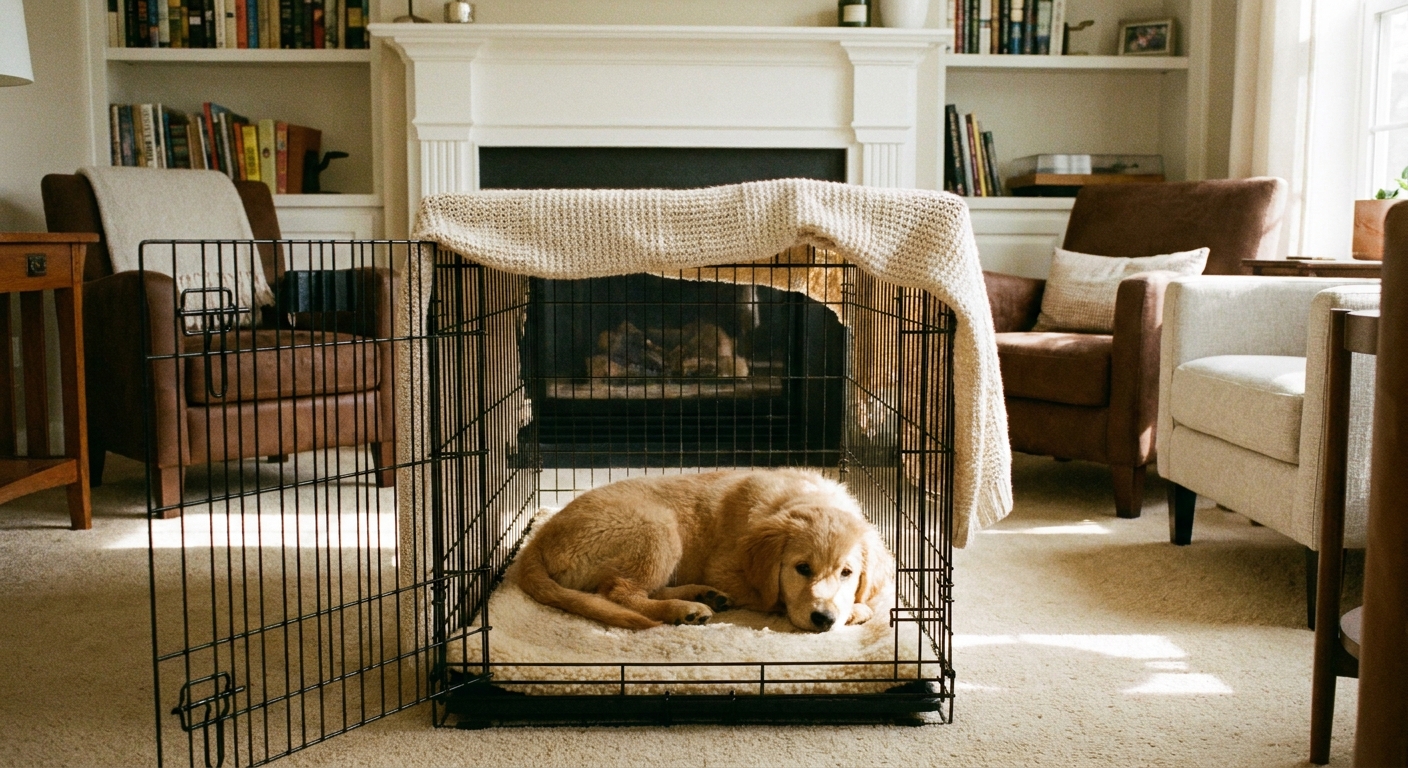
Crate size: the Goldilocks rule
A crate should be big enough for your puppy to stand up, turn around, and lie down comfortably. Bigger is not automatically better. If it is cavernous, some puppies feel exposed and unsettled. And in some puppies, a too-large crate can make it harder to settle because there is more room to pace and stay visually engaged with everything around them.
How to pick the right size
- Standing height: Your puppy should not crouch or duck their head to stand.
- Turning space: They should be able to turn around naturally without bumping the sides.
- Sprawl allowance: Many puppies like to sleep on their side with legs out. That is okay, as long as the crate is not so big it feels like a warehouse.
If you bought a crate sized for your puppy’s adult weight, use a divider panel so the usable space grows with them. This helps the crate stay cozy and can prevent habits like pacing or treating one end like a hangout and the other end like a bathroom.
Wire, plastic, or soft-sided?
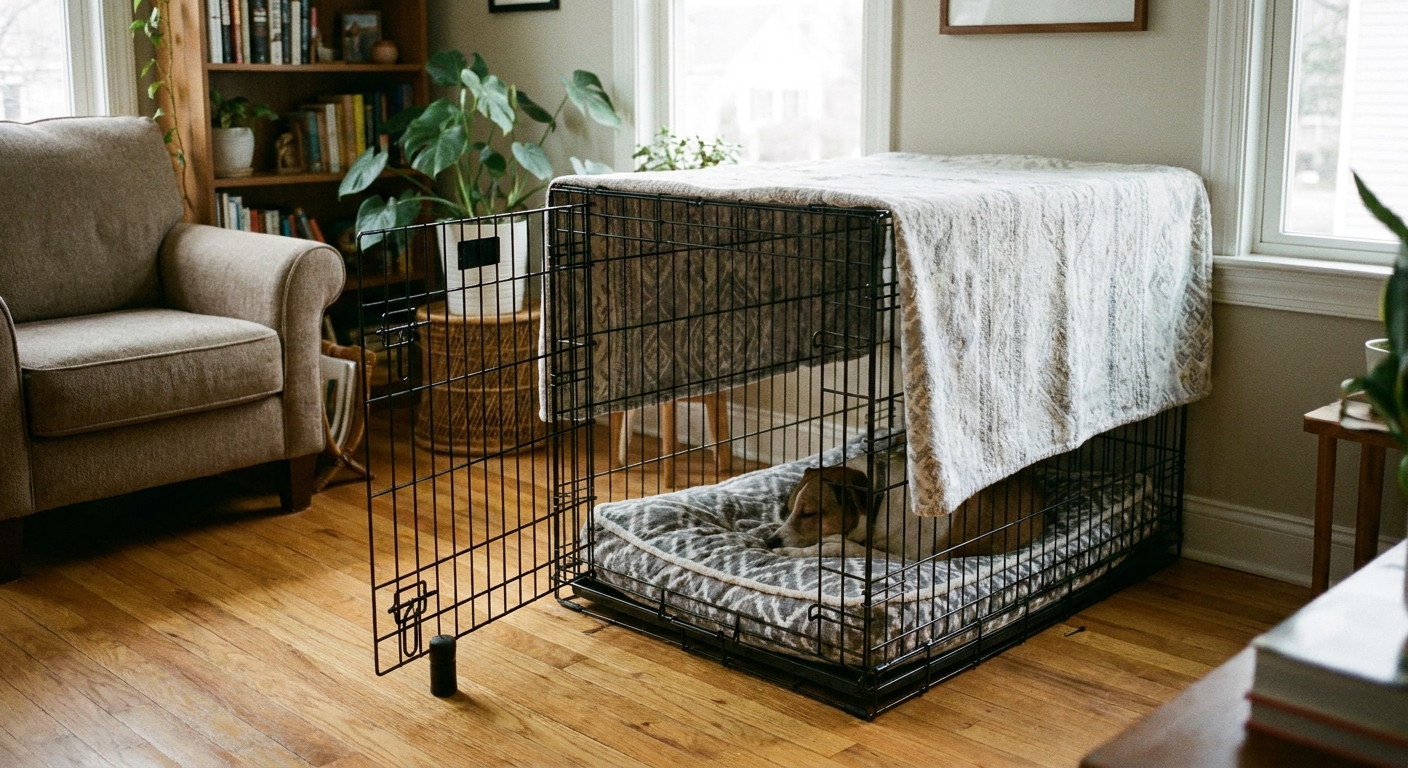
- Wire crates: Great airflow, easy to clean, and easy to cover with a blanket for a den-like feel. Many puppies settle well in them.
- Plastic airline-style crates: Often feel more den-like and can reduce visual stimulation. Great for puppies who get worked up watching the world.
- Soft-sided crates: Best for already crate-trained dogs or very calm puppies. Many teething puppies can chew through mesh surprisingly fast.
Set the crate up to feel safe
Before you worry about timing or schedules, make the crate physically inviting. A puppy who is comfortable is a puppy who can learn.
Location matters
Start with the crate in a social area where your puppy naturally wants to be, like the living room. For nighttime, many families do best with the crate in the bedroom or close enough that your puppy can hear you breathe and shift in bed. You can always move it later once sleep is stable.
What to put inside
- A firm, washable mat or pad. Some puppies shred fluffy bedding at first. Safety beats aesthetics.
- One safe chew or enrichment item (more on that below).
- A light cover over part of the crate if your puppy settles better in a dimmer space. Keep airflow open on at least one side.
Avoid anything your puppy can easily rip and swallow. If your puppy is an enthusiastic chewer, skip thick blankets until you are confident they will not ingest fabric.
Quick crate safety checklist
- Collar off in the crate. Collars and dangling tags can snag on crate bars.
- Choose chews carefully. Avoid anything that splinters, gets gummy, or is small enough to swallow. When in doubt, ask your veterinarian what is appropriate for your puppy’s age and chewing style.
- Watch cords and curtains. Place the crate where your puppy cannot reach electrical cords, blind strings, or anything they can pull into the crate.
- Keep water simple. For short crate sessions, many puppies do fine without water. For longer daytime confinement, use a crate-safe water bowl that cannot tip, and confirm with your veterinarian if your puppy has any medical reasons to keep water available.
Make the crate predict good things
The quickest way to build a positive crate association is to make the crate the place where your puppy’s favorite things happen. This is where feeding meals in the crate shines.
Feeding meals in the crate
For most puppies, meals are a built-in training session. Start with the door open.
- Place the bowl just inside the doorway.
- Over a few meals, slide it farther back as your puppy stays relaxed.
- Once your puppy is happily walking in, you can briefly close the door while they eat.
- Open the door before they finish if you are seeing tension or frantic gulping. We want calm, not “I have to eat before I get trapped.”
If your puppy is hesitant, do not push or lure them deep inside with pressure. Sprinkle a few pieces of kibble just inside the entrance and let them choose to step in.
Use a “crate treat” that only happens in the crate
Pick one high-value, low-drama activity that becomes your puppy’s crate ritual. My go-to options:
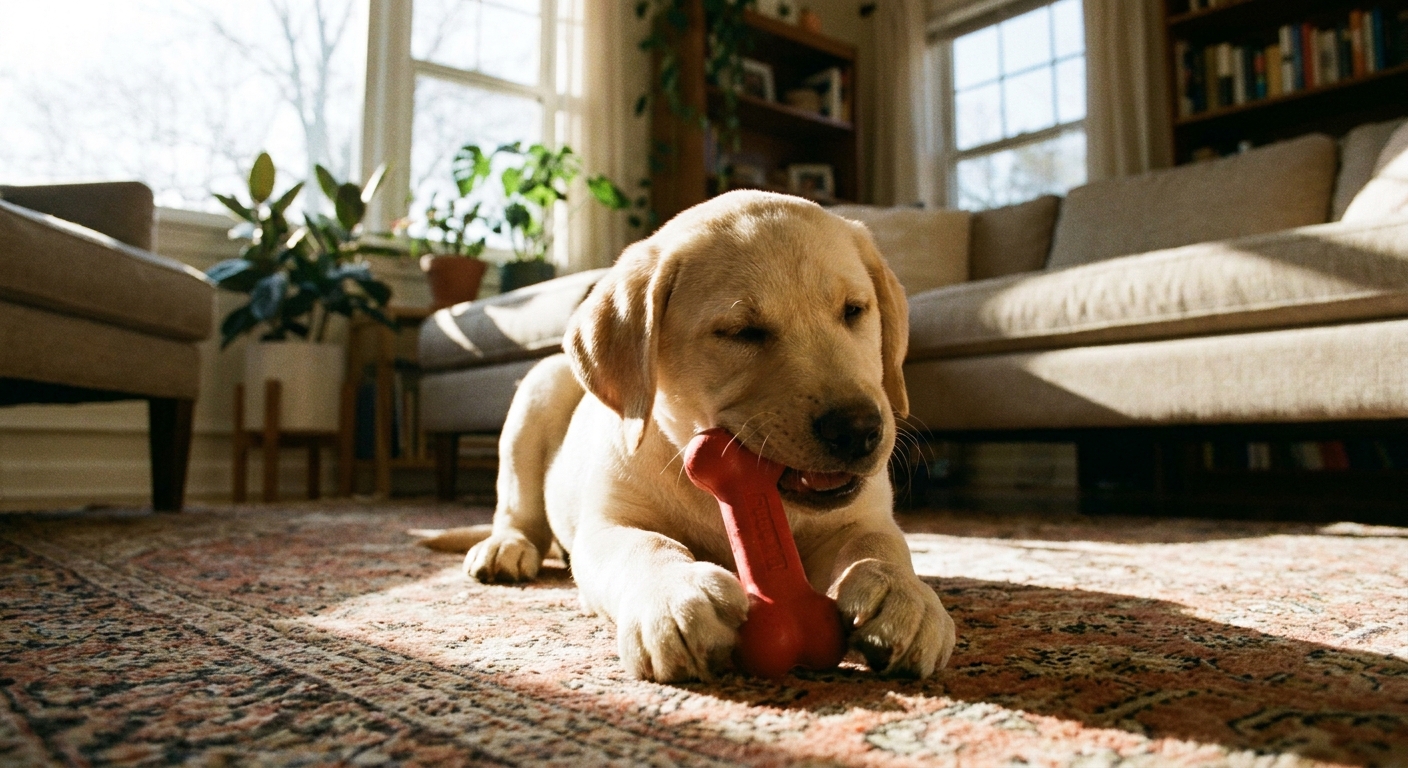
- Stuffed food toy (kibble mixed with a little canned food or a tiny amount of plain, unsweetened, xylitol-free yogurt, then frozen). If dairy is new for your puppy, start with a very small amount since some pups are sensitive.
- Long-lasting chew approved for puppies and supervised at first.
- Snuffle activity that encourages sniffing and settling. Supervise until you know your puppy will not shred or eat the fabric, and remove it if they start to destroy it.
Keep it consistent. Predictability is calming for puppies.
Timing: how long can a puppy stay crated?
This is the question I wish the internet answered more gently. There is a difference between training time (short, upbeat practice) and confinement time (a nap, a meeting, a car ride, a safe pause). Puppies are still developing physically and emotionally, so we use the crate in ways that support both.
Age-based guidelines
These are common, puppy-friendly starting points for awake-time crating, not guarantees or hard “maximums.” Potty needs, separation distress, breed traits, and individual development matter. Naps can run longer because your puppy is sleeping, which is exactly what we want.
- 8 to 10 weeks: often 30 to 60 minutes while awake. Many puppies this age do best with multiple small sessions, not one long one.
- 10 to 12 weeks: often 1 to 2 hours while awake, depending on how well they settle.
- 3 to 4 months: often 2 to 3 hours while awake, with breaks.
- 4 to 6 months: many can work up to 3 to 4 hours during the day if their needs are met and they are comfortable with the routine.
Even when a puppy technically can tolerate longer, that does not always mean they should. If you notice your puppy gets more frantic the longer they are crated, treat that as information, not disobedience.
Two timing principles that prevent most crate struggles
- Crate after needs are met: A puppy settles best after they have had a chance to move, sniff, chew, and connect with you.
- End sessions on calm: If possible, wait for a brief quiet moment before opening the door. You are reinforcing the emotional state you want: calm gets you out.
Building alone time
The biggest crate training win is not “my puppy tolerates the crate.” It is “my puppy can relax when I am not right there.” We build that like a staircase, not a leap.
Step 1: Door open, puppy chooses to enter
Toss a treat in, let them step in, then let them come right back out. Repeat a few times. Keep it light and almost boring.
Step 2: Door closes briefly, you stay nearby
Give your puppy their crate treat, close the door, sit next to the crate, and quietly scroll or read. Start with 30 to 60 seconds, then open the door during a calm moment. Gradually increase.
Step 3: Add distance, then short disappearances
Once your puppy is calmly working on the treat, stand up, take one step away, then come back. Then two steps. Then leave the room for five seconds. Your goal is “I leave and return and nothing scary happens.”
Step 4: Normalize a full nap
When your puppy can settle with you in another part of the room, start doing real-life things: dishes, folding laundry, a shower. If your puppy wakes and fusses, you may have increased difficulty too fast. That is normal. Step back to the last successful version and rebuild.
If your puppy consistently panics when you are out of sight, even with slow steps, you may be dealing with separation-related distress rather than normal puppy protest. That is fixable, but it often goes best with a structured plan and professional support.
Night crying: what to do
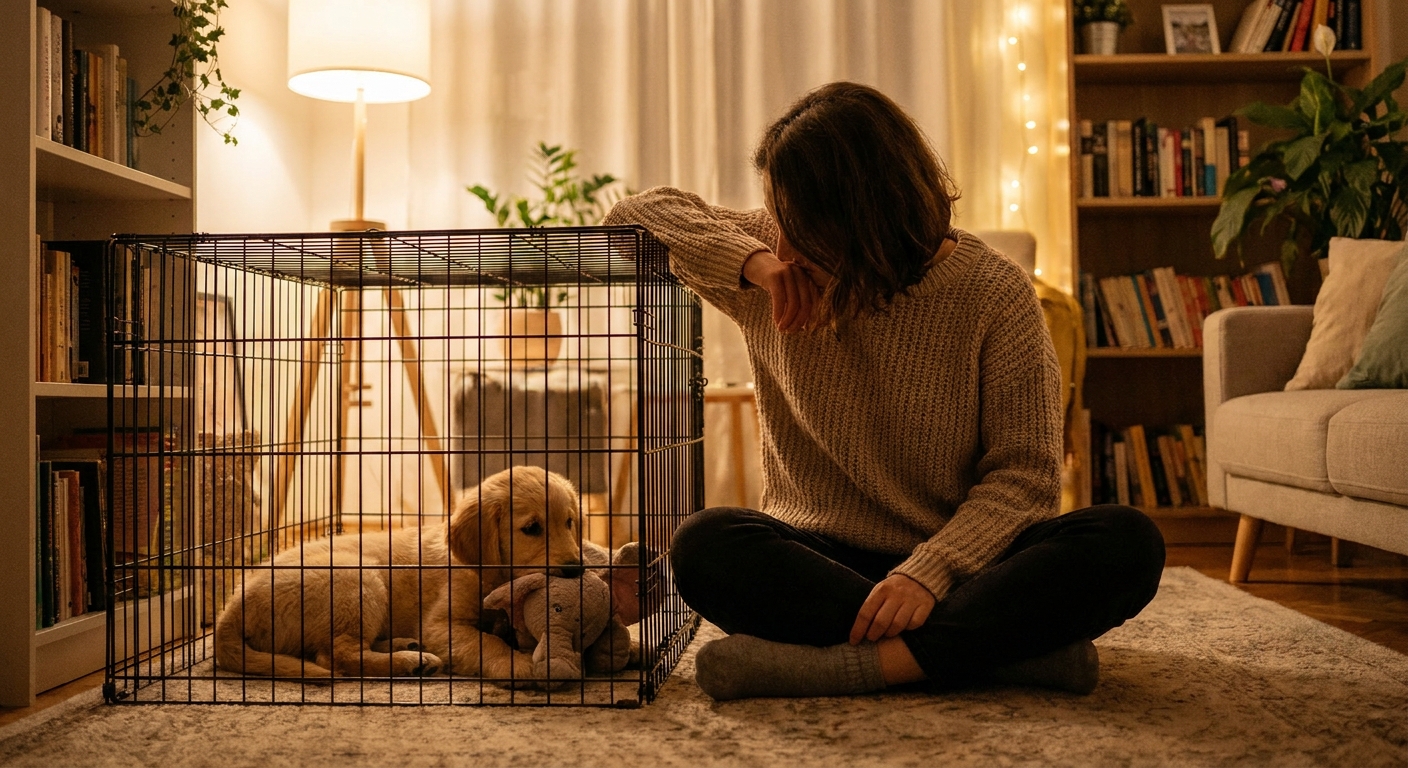
Night crying is incredibly common, especially in the first week. Your puppy has gone from sleeping in a warm pile of siblings to sleeping alone in a new place with new sounds. That is not manipulative. That is mammal behavior.
Set your puppy up for quieter nights
- Keep the crate close to you: Many puppies settle faster when they can see or smell you. If sleep improves, you can slowly increase distance over days or weeks.
- Use steady sound: A fan or white noise can mask house creaks and street sounds.
- Offer a comfort object: A safe plush toy can help some puppies. Skip anything they can destroy and swallow.
- Keep the bedtime routine predictable: Same order, same calm energy, same cue word.
Overnight potty basics
This is where a lot of families get stuck, so here is the simple version that helps most puppies:
- Potty right before bed. Make it the last boring stop of the night.
- Expect overnight potty breaks early on. Many young puppies need at least one trip overnight. Age, size, and what time dinner and water happen all affect this.
- Keep it quiet and brief. Low lights, minimal talking, no play. Potty, praise softly, back to the crate.
- Carry them if needed. For some puppies, being carried out and back reduces the “it is party time” effect.
When your puppy cries, use a calm decision tree
I like to think of night crying as one of three things: needs something, is scared, or has learned that noise makes the door open. Early on, it is usually the first two.
- First, pause and listen for 10 to 20 seconds. Some puppies fuss, reposition, then fall asleep. If you rush in instantly every time, you may accidentally prevent them from learning self-soothing.
- If crying escalates, respond quietly. Speak softly from your bed first: “Shh, you are okay.” If they settle, great.
- If they do not settle, take them out calmly and briefly. Keep lights low, keep your voice neutral, and do not turn it into playtime. Then back to the crate.
If your puppy is panicking to the point of intense thrashing, heavy drooling, vomiting, or trying to bite the crate, that is not “being dramatic.” That is distress, and it can be behavioral stress or medical discomfort like nausea or pain. Back up your plan by moving the crate closer and shortening the time, and also loop in your veterinarian if anything seems physically off.
What not to do for night crying
- Do not bang on the crate or yell. It can make the crate feel unsafe.
- Do not use the crate as a threat (“If you do not stop, you are going in the crate”). Puppies remember tone more than words.
- Do not let the crate become the only place they are ever alone. If crate time always equals your disappearance, you can accidentally build a strong “crate predicts isolation” association.
If you are on night three and you are exhausted, you are not failing. You are in the hardest stretch of adjustment. Most puppies improve dramatically when the crate is close, the routine is consistent, and alone time is built in tiny steps during the day.
How the crate becomes “punishment”
The crate itself is neutral. We teach the meaning. Here are the most common habits that make puppies hate the crate, even in loving homes.
Common pitfalls to avoid
- Only crating after “bad behavior.” If crate time always follows scolding, your puppy will connect the crate with conflict and rejection.
- Using the crate when your puppy has not decompressed. A puppy bouncing off the walls needs appropriate outlets first. Confinement can feel unfair and spark more vocal protesting.
- Opening the door during loud, frantic vocalizing. This teaches “scream harder.” Instead, wait for a tiny pause, then open.
- Going too fast on alone time. Long crate sessions before your puppy is ready often look like stubbornness, but they are really stress.
- Inconsistent rules. If sometimes the crate means a tasty chew and sometimes it means isolation after yelling, your puppy will stay on edge, waiting to see which version they get.
You can absolutely use the crate to keep everyone safe during chaotic moments. The key is what happens right before and right after. Pair it with something good, keep your tone neutral, and do a little “crate positivity” practice later when you are both calm.
Crate rest and confinement
Sometimes crate time is not a training choice. It is medical. After surgery, with an injury, or during certain illnesses, your veterinarian may prescribe crate rest to limit movement and protect healing tissues.
How crate rest is different
- It is stricter. Your puppy may be confined far more than normal, often with limited walking, jumping, or play.
- Comfort and enrichment matter more than ever. A bored puppy on crate rest can become a stressed puppy fast.
- Follow your vet’s instructions exactly. The safest amount of movement depends on the condition and procedure.
Making crate rest easier
- Ask your vet about calm enrichment options that fit your puppy’s medical restrictions.
- Use food puzzles that do not encourage intense pawing if movement is limited.
- Keep the crate in the heart of the home so your puppy does not feel isolated while they recover.
- Talk to your vet about medication if your puppy cannot settle. Pain and anxiety can look similar. Both deserve support.
If crate rest has been prescribed and your puppy is suddenly crying, panting, drooling, vomiting, or unable to get comfortable, call your veterinary clinic. It may be pain, nausea, or discomfort from the setup, and you do not have to guess.
Troubleshooting
Even with a solid plan, most puppies hit a few bumpy spots. These are the quick adjustments that tend to get you back on track without turning everything into a big emotional project.
My puppy only cries when I leave the room
That is a sign the “alone” part is too hard right now. Make the next sessions easier: return to sitting near the crate, then add distance in tiny steps. Give the special crate-only chew right as you step away.
My puppy settles, then wakes up and screams
This often happens when the crate is too stimulating (busy hallway, barking sounds outside) or your puppy has not fully learned how to fall back asleep. Try moving the crate to a quieter spot at night, using white noise, and practicing short “wake up and resettle” moments during the day with a calm chew.
My puppy is chewing the crate or digging at bedding
Remove unsafe bedding, offer an appropriate chew, and make sure the crate is not the only outlet for chewing behavior. If chewing looks frantic or obsessive, scale back alone time and consult your vet or a qualified trainer.
My puppy will not go in the crate
Stop closing the door for a few days. Feed meals near the crate, toss treats in and out, and praise any voluntary step inside. Forcing a puppy into the crate can create a long-lasting aversion.
When to get extra help
Most crate training struggles improve with slower steps and better associations. But sometimes you are seeing more than normal puppy fussing.
Consider speaking with your veterinarian and a qualified positive reinforcement trainer if you notice:
- Drooling, vomiting, or signs of physical discomfort when crated
- Persistent panic that does not improve with gradual training
- Escaping and damaging teeth or nails on the crate
- A sudden change in comfort with the crate (which can suggest pain or illness)
You are not overreacting by asking for help. Early support can prevent a small problem from becoming a big one.
My favorite calm-start routine
If you want a simple plan to begin today, this is the routine I used with countless clients and with my own dogs.
- Morning: Short crate session with a stuffed food toy while you sit nearby (2 to 5 minutes at first).
- Midday: Meal served in the crate with the door open, then a brief door close while they finish, then open again.
- Afternoon: Practice one tiny “disappearance” (leave the room for 5 to 15 seconds) while they work on a chew.
- Evening: Calm crate time while you watch TV or read in the same room, then bedtime with the crate close to you.
It is repetitive by design. Puppies thrive on repetition. And the more often your puppy experiences the crate as predictable and safe, the faster the crying fades.
FAQ
Should I ignore my puppy crying in the crate at night?
Not as a blanket rule. Brief fussing can be normal, and pausing for a few seconds can give your puppy a chance to settle. But intense, escalating crying deserves a calm response. Early on, many puppies need reassurance and a predictable routine more than “cry it out.”
Is it okay to let my puppy sleep in my bed instead?
That is a personal choice, but it is not an automatic substitute for crate training. Even bed-sleeping families usually need crate comfort for travel, grooming, vet visits, or medical confinement. You can teach the crate kindly even if your puppy does not sleep in it every night long-term.
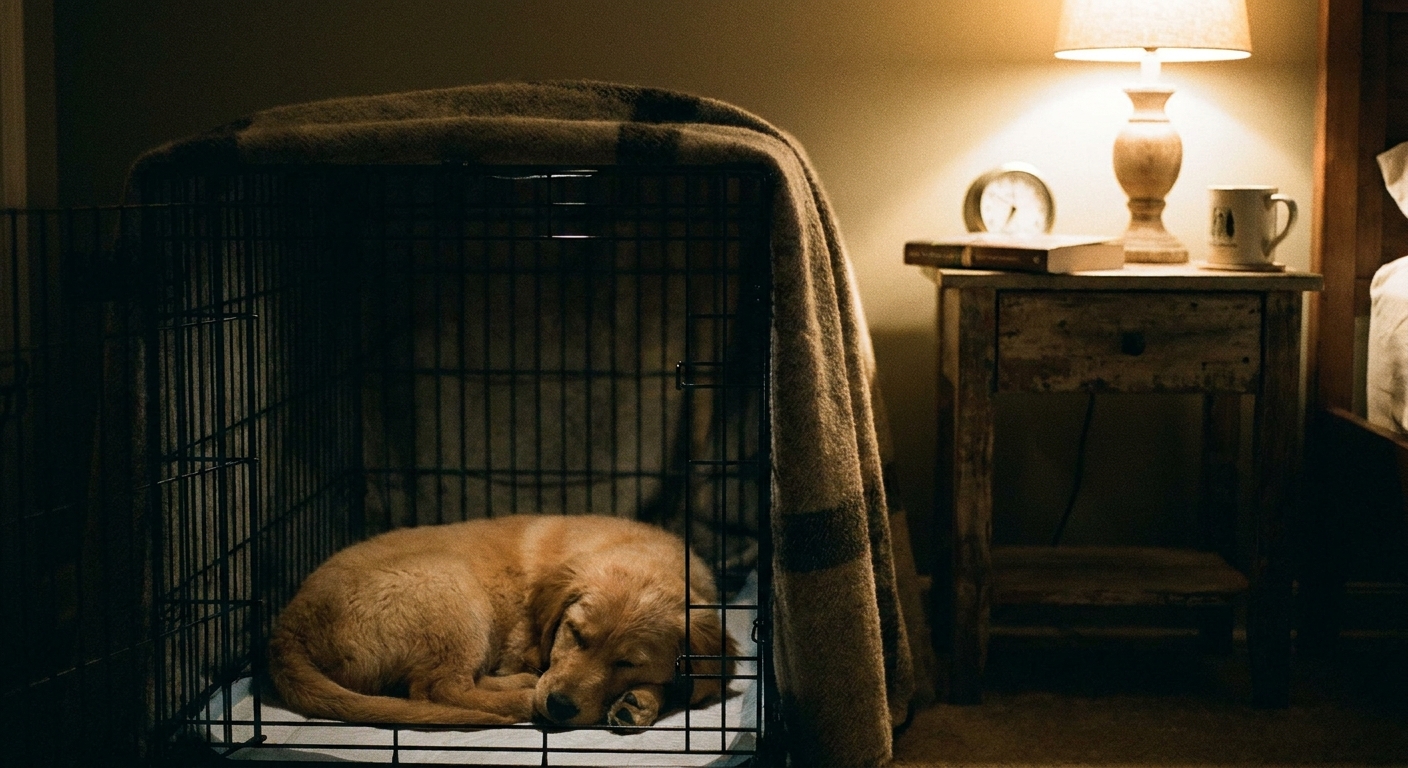
Should the crate be dark and covered?
Some puppies settle better with partial coverage because it reduces stimulation. Others get hotter or feel more anxious if airflow is limited. Start with a light cover over the top and one side, and adjust based on your puppy’s comfort and the room temperature.
Can I use the crate for time-outs?
I prefer not to. If you need a safe pause, use a puppy-proofed pen area or tether your puppy nearby with a chew, then later do a separate, positive crate session. Protecting the crate’s “good place” reputation pays off for years.
Any tips for car crating?
Use a securely placed crate that cannot slide, and never leave your puppy crated in a hot car. For longer rides, plan for safe breaks for water and potty.