A practical, judgment-free comparison of clicker training and voice cues, including benefits, downsides, and when to use each for better behavior and faster ...
When I worked as a veterinary technician, one of the most common, most stressful home complaints I heard was: “My dog loses it at the doorbell.” It is right up there with “He barks at everything out the window” and “She goes outside and just… yells at the yard.” If that is your house, you are not failing your dog. Barking is normal dog behavior. The goal is not silence 24/7. The goal is helping your dog feel safe and teaching them what to do instead of sounding the alarm for every passerby.
Below is my go-to approach for doorbells, windows, and backyard barking. It is built on two things that work together: smart management (so your dog is not rehearsing the behavior all day) and training (so calm becomes the habit).
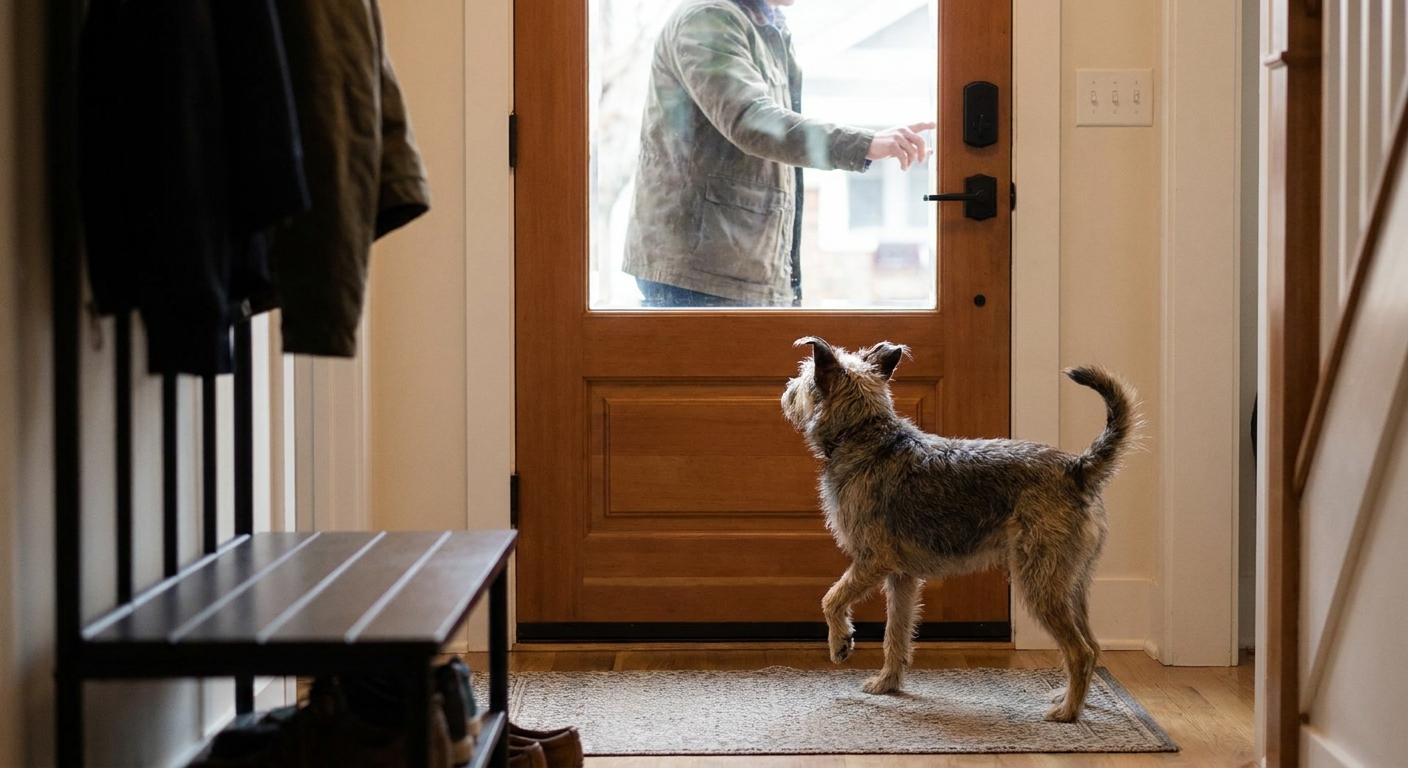
Why dogs bark at the door, window, or yard
Most barking in these scenarios is alert barking (I heard something, I saw something) that can tip into nuisance barking (it has become a self-rewarding habit). Common reasons include:
- Territorial instinct: Your home, your window, your fence line. Many dogs feel responsible for reporting activity.
- Startle response: Doorbells are sudden and loud. Even confident dogs can jump to high alert.
- Barrier frustration: A dog who wants to greet or chase cannot access the person or dog outside, so the energy comes out as barking.
- Reinforcement history: Barking “works” from your dog’s perspective because the trigger usually goes away. The mail carrier leaves. The jogger passes. Your dog concludes, “My barking handled it.”
- Boredom and under-enrichment: In the yard especially, barking can be the most exciting thing available.
- Genetics and breed tendencies: Some dogs are simply more vocal or more watchful. That is not bad. It just means you may need stronger management.
If your dog’s barking seems driven by panic, happens mostly when you are gone, or comes with destruction and drooling, that is a different category. This guide stays focused on doorbells, windows, and the yard.
Barking vs fear and aggression
Most door and window barking is a dog saying, “Something is happening.” But some dogs are not just alerting. They are afraid, and their behavior can escalate quickly.
- More like alert barking: A few barks, then your dog can turn away, take food, and recover with your help.
- More like fear or defensive behavior: Hard staring, stiff body, growling that escalates, lunging, snapping, or the inability to settle even after the person is gone.
If you see the second pattern, do not try to “test” your dog with more visitors. Get support. A reward-based trainer with recognized credentials (like CCPDT, IAABC, or KPA) can be a great start, and for serious cases a veterinary behaviorist (DACVB) is the gold standard.
What makes barking worse (even when you mean well)
I say this with so much empathy because I have done it too: a lot of common human reactions accidentally add fuel.
- Yelling “Quiet!” repeatedly: Many dogs interpret this as you joining the barking. To them it can sound like, “Yes, I see it too, keep going!”
- Rushing to the window with your dog: You just confirmed the trigger is important.
- Letting your dog camp at the window all day: Rehearsal builds habit, and endurance. The more they practice, the better they get at it.
- Opening the door while your dog is barking and lunging: The barking chain becomes the door-opening routine.
- Inconsistent rules: Sometimes barking is allowed (cute alert), other times it is punished (annoying alert). That unpredictability can increase arousal.
- Punishment tools: Shock or spray collars may suppress sound temporarily, but they do not teach safety or a replacement behavior. They can also increase fear or anxiety, or worsen reactivity in some dogs, especially if the dog starts associating the door or window with something unpleasant.
Instead, we want to lower the volume on the trigger and raise the value of calm.
Step 1: Block or soften the trigger first
Training goes faster when your dog is not practicing the unwanted behavior 40 times a day. Management is not cheating. It is how you create room for learning.
For window barking
- Use visual blockers: Frosted window film, rearranging furniture away from the window, or keeping blinds partially closed during high-traffic times.
- Create a “viewing station” with rules: If your dog loves to look outside, give a specific spot that is not right against the glass, then reinforce quiet looking and call-aways.
- Use white noise: A fan or white-noise machine can take the edge off outdoor sounds that trigger barking.
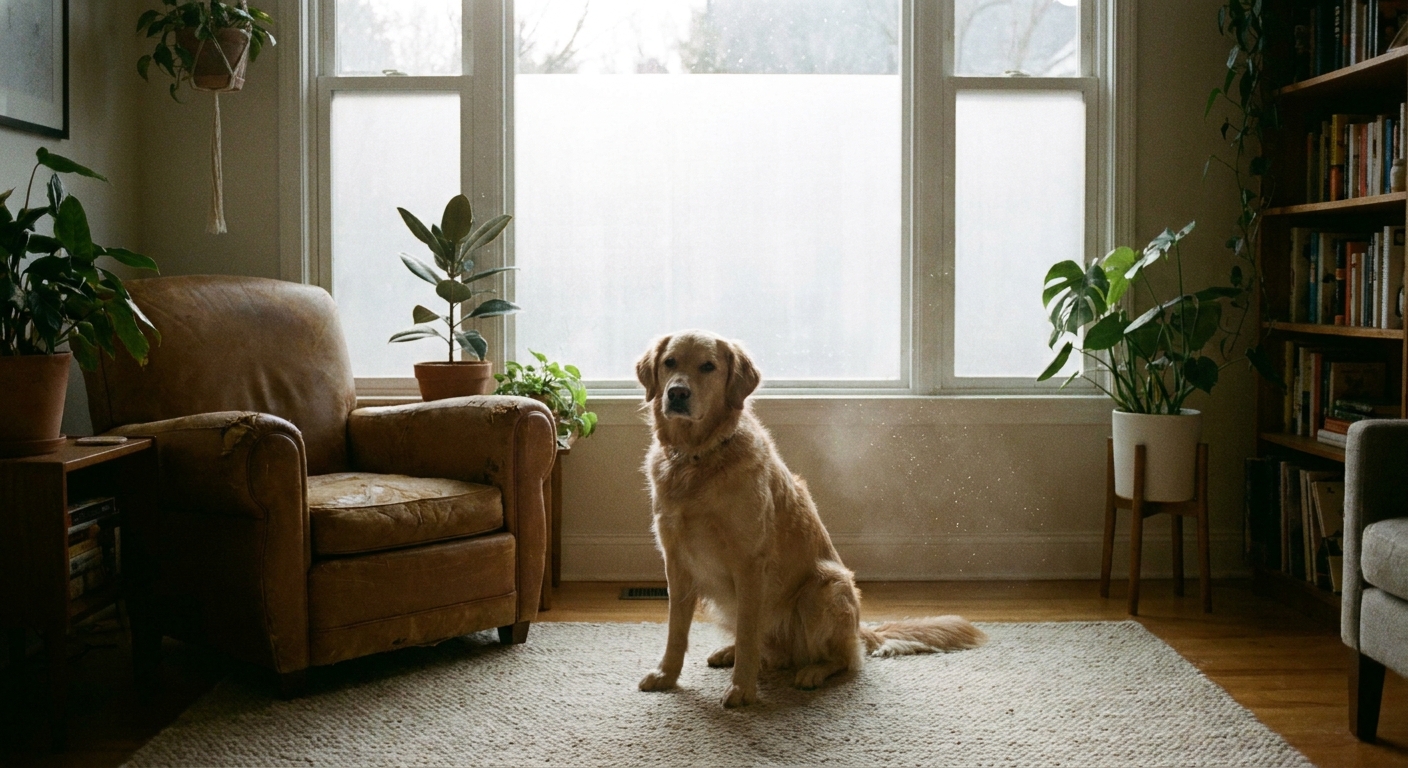
For doorbell and front door chaos
- Mute or lower the doorbell: If your doorbell has volume settings, start there. If not, consider using a temporary sign asking visitors to knock softly or text on arrival while you train.
- Set up a baby gate or exercise pen: Physical distance from the door reduces arousal and keeps everyone safe when the door opens.
- Have a “treat station” by the door: You want rewards within reach so you can reinforce calm immediately.
For yard barking
- Supervise: If barking is the default, unsupervised yard time often becomes barking practice.
- Block fence-line views: Outdoor privacy screens or strategically placed planters can reduce the number of visual triggers.
- Bring them in before they spiral: Do not wait until they are in full patrol mode. Intervene early, then reinforce the calm transition inside.
- Avoid “bark it out” time: Leaving a dog outside to bark until they tire out usually increases arousal, strengthens the habit, and can create neighborhood conflict.
Step 2: Teach a reliable “quiet” cue
“Quiet” is a skill, not a scolding. The easiest way to teach it is to set your dog up to succeed when barking is mild, then pay them for silence.
How to teach “quiet” in real life
- Wait for a bark or two. We are not trying to stop the first alert bark. One or two barks is communication. We are preventing the barking from snowballing.
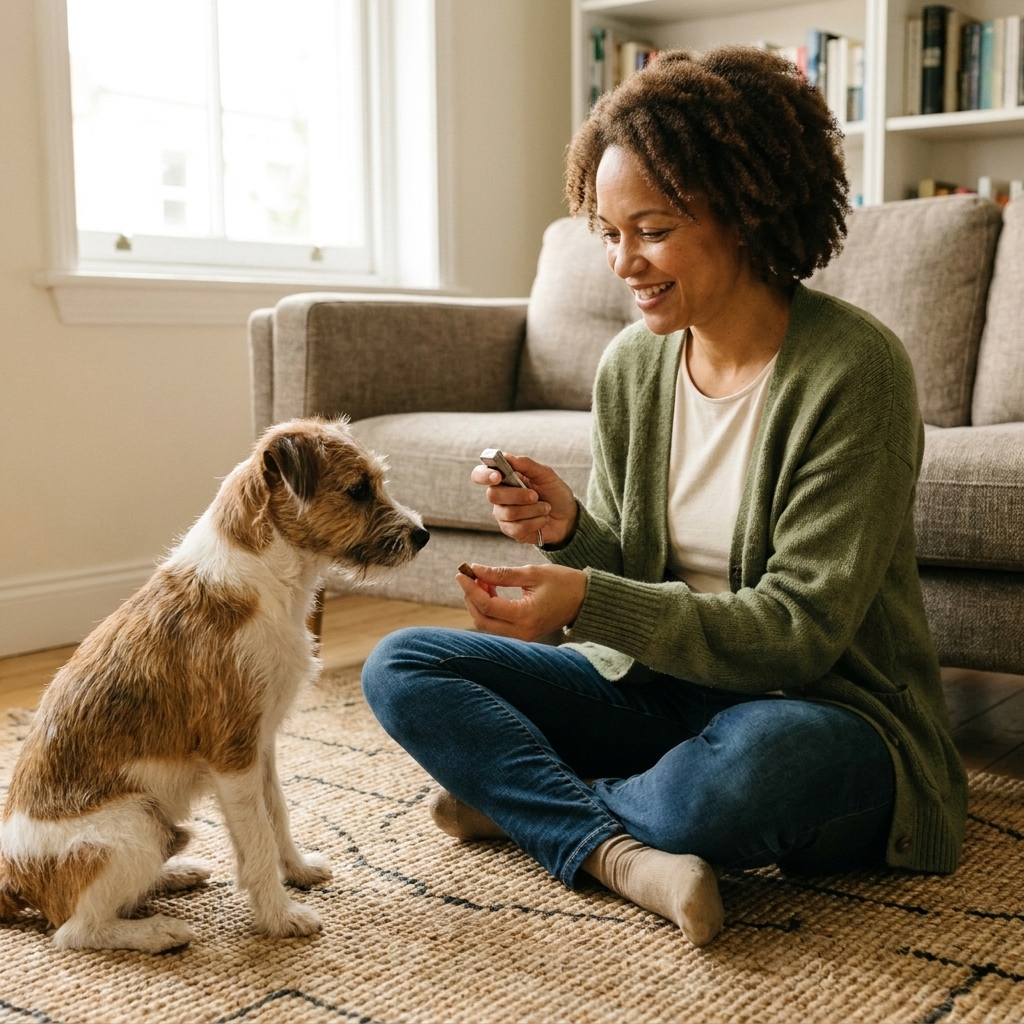
- Hold a high-value treat to their nose. Most dogs pause barking to sniff.
- The moment they stop, say “Quiet.” Calm voice. No anger. This is just information.
- Feed immediately. You are paying for silence.
- Repeat, then add a tiny delay. After a few reps, wait one second of quiet before treating, then two seconds, then three.
Important timing note: If you offer food while your dog is actively barking, you can accidentally reinforce barking. The “magic moment” is the first half-second of quiet, even if it is just a pause to breathe. Catch that pause and pay it.
Tip from the clinic: If your dog is too worked up to take food, that is a data point. You need more distance from the trigger or better management before training will stick.
Once “quiet” is working with mild triggers, practice with slightly harder ones. Build gradually. Doorbells are often advanced mode, so do not start there if your dog goes from zero to siren instantly.
Step 3: Teach “go to mat”
It is hard to bark at the window if your dog is across the room on a mat chewing a treat. It is hard to rush the door if your dog is behind a gate on a bed. This is why trainers love a solid go to mat behavior for household triggers.
If you prefer the cue “place” or “bed,” that is fine. I am going to call it “mat” here for simplicity.
Quick start: building a mat habit
- Put a comfy mat or bed down in a quiet area with a clear view of you.
- Any time your dog steps onto it, drop a treat on the mat.
- Once they start seeking it out, add the cue “Mat.”
- Start feeding multiple treats in a row while they stay on it.
- Add duration with a chew, stuffed food toy, or scatter of treats.
Now you have somewhere for your dog to go when the doorbell rings, rather than something you are trying to stop them from doing.
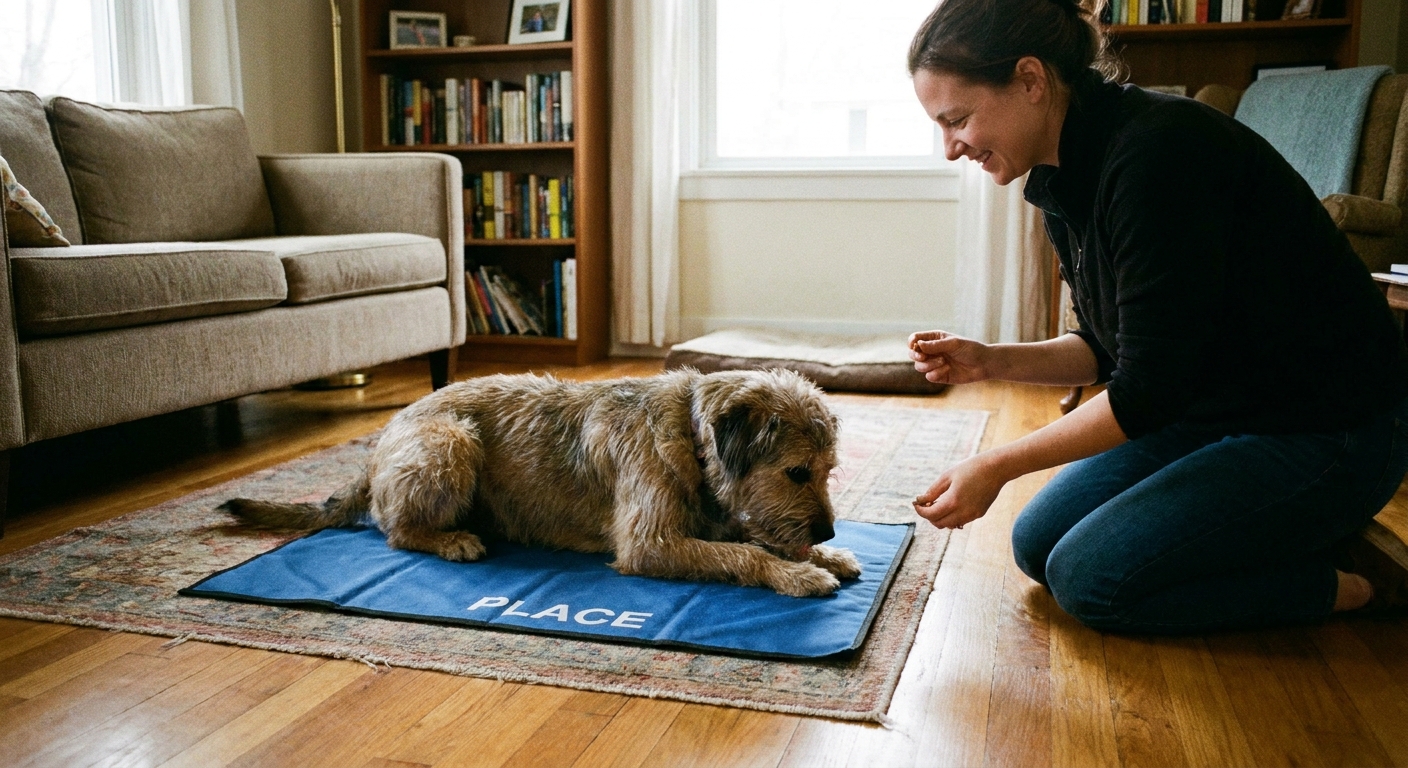
Doorbell routine (goal: calm and contained)
- Step 0: Before you open the door, your dog is secured. Use a gate, leash, or a closed interior door. This protects your dog, your guests, and you.
- Step 1: Doorbell rings.
- Step 2: You cue “Mat.”
- Step 3: Reward heavily once they are on the mat. Use the gate or leash as needed.
- Step 4: Only approach the door when your dog is quiet or at least trending calmer.
In the beginning, you may need to toss a handful of treats on the mat as a “find it” game to get quick buy-in. That is fine. We can make it elegant later.
Visitor coaching helps: For high-arousal dogs, ask guests to ignore your dog at first (no looming, no reaching, minimal eye contact) and toss treats away from their body. This lowers pressure and helps your dog stay in thinking mode.
Step 4: Practice with setups
Real triggers are messy. Training is cleaner when you can control volume, distance, and repetition.
Doorbell practice session
- Recruit a helper or use a doorbell sound at low volume.
- Start easy: One ring at a low level.
- Mark and reward calm: Treat for looking at you, going to mat, or being quiet after the cue.
- Short sessions: 3 to 5 minutes, then break. Over-tired brains bark more.
Window practice session
- Catch the calm moments: If your dog looks out and stays quiet, reward that. We want them to learn that quiet observation pays.
- Pattern game: If your dog sees a trigger and tenses, calmly say “This way” and toss treats away from the window. Repeat until turning away becomes automatic.
- Increase difficulty slowly: Busier times of day, closer triggers, blinds more open, and so on.
Progress looks like shorter barking bursts, quicker recovery, and fewer full-body meltdowns. Those are wins even if you still hear some barking.
Step 5: Meet the needs behind barking
Training is much easier when the dog in front of you has a full cup. A bored dog with excess energy will choose barking because it is stimulating and it relieves tension.
Exercise that actually helps
- Sniffy walks: Letting your dog sniff is legitimate enrichment and often more settling than a fast march.
- Short training bursts: Five minutes of cues and reward-based focus can be more tiring than 20 minutes of yard roaming.
- Fetch with rules: If fetch revs your dog into a frantic state, switch to calmer games or enforce breaks.
Enrichment for the yard barker
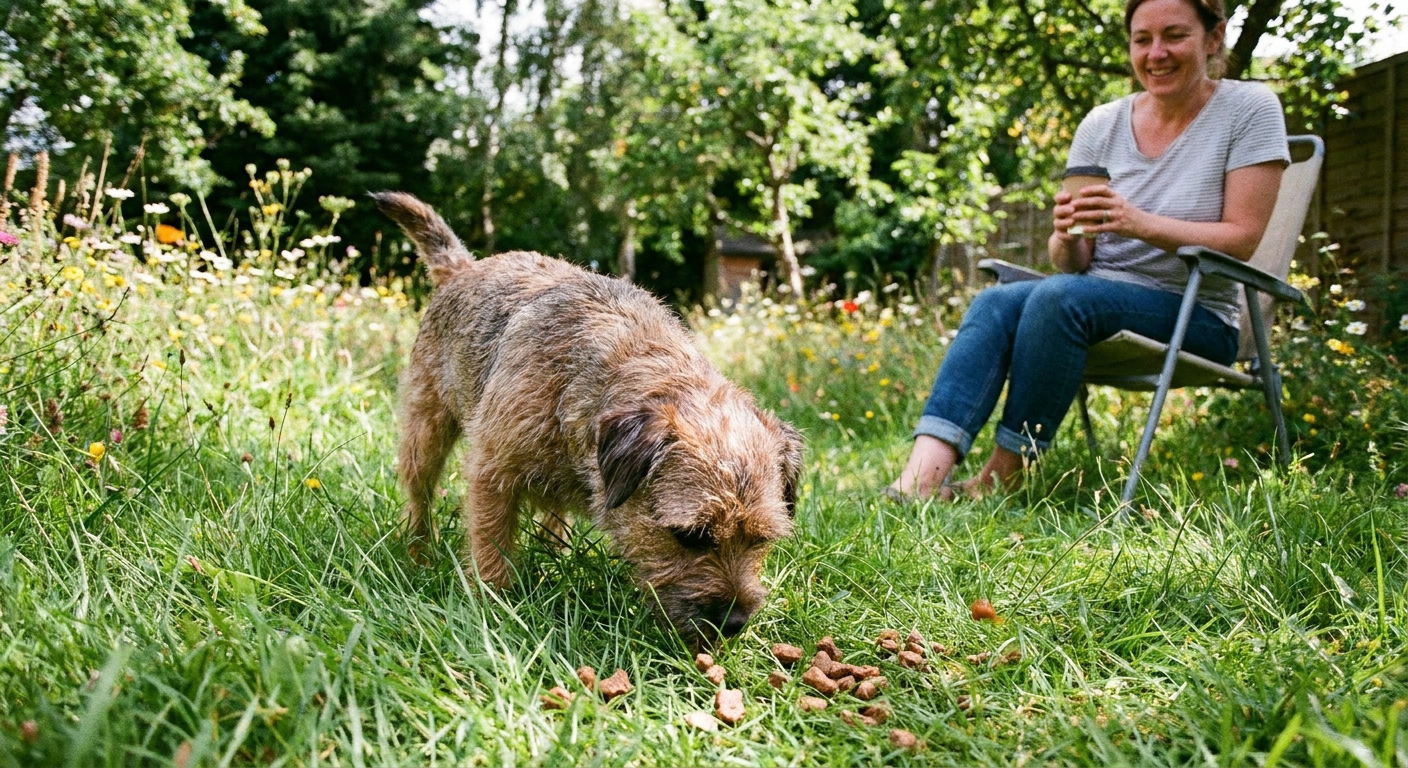
- Food scatters in the grass: Toss kibble or treats for a natural foraging session.
- Dig box: A designated sandbox or dirt box with buried toys can redirect the need to “do something.”
- Rotate toys: Novelty matters. Put half the toys away and swap weekly.
- Supervised outdoor time: Yard time is not always enriching by itself. Many dogs just stand at the fence waiting for something to bark at.
If you have a dog who goes from calm to explosive at every tiny sound, talk with your veterinarian. Pain, anxiety, cognitive decline, and vision or hearing changes can all lower a dog’s threshold and make them more reactive or more easily startled.
When to intervene and when to let it go
One of the most helpful mindset shifts for door and window barking is separating information barking from spiral barking.
- Usually okay: One to three barks to alert, then they stop when you acknowledge and redirect.
- Time to intervene: Barking that escalates, lasts more than a minute, or repeats over and over because your dog is “on duty” all day.
You can even teach an “All done” cue that means you have checked and the situation is handled. Pair it with calling your dog away and rewarding them for disengaging.
Troubleshooting common sticking points
My dog barks and will not take treats
You are too close to the trigger or the trigger is too intense. Add distance, block the view, lower the doorbell volume, or start training at a calmer time of day. You can also test higher-value rewards like chicken, cheese, or a lickable treat.
My dog runs back to the window after I call them away
That usually means the window is still more rewarding than you are. Increase the payoff for staying away (more treats, longer chew, more praise if your dog enjoys it) and reduce access (move furniture, use film, or close off that room during peak times).
The doorbell is the biggest trigger of all
Doorbells combine sound, anticipation, and people at the entry. Lean harder on management while you train: gate your dog, practice with a fake doorbell sound at low volume, and build the mat behavior until it is automatic before you add real visitors.
My dog only barks in the yard
That is often a combination of boredom and perimeter guarding. Supervise, limit fence-line access, and make yard time an activity you provide, not a shift your dog works alone.
Sample daily plan
If you feel overwhelmed, this is a realistic starting point that helps fast without asking you to be a full-time dog trainer.
- Morning: 10 to 20 minute sniffy walk, then 3 minutes of “mat” practice with breakfast (toss a piece of kibble onto the mat, repeat).
- Midday: Block window access during peak traffic, then give a chew or stuffed food toy on the mat for 10 minutes.
- Evening: 3 to 5 minutes of doorbell practice at low volume, then an easy enrichment game in the yard (food scatter) with supervision.
Consistency beats intensity. Small reps done often build the habit you want.
Safety notes and when to get extra help
Seek help from a qualified, reward-based professional if:
- Your dog’s barking includes snapping, growling that escalates, or attempts to bite when someone enters.
- Your dog cannot recover for a long time after a trigger, even with distance and food.
- You have a large dog and visitors are at risk if the door opens unexpectedly.
If you ever feel unsure, start with your veterinarian to rule out pain or medical issues, then ask for a trainer referral. You deserve support, and your dog deserves a plan that feels safe.
FAQ
Should I ignore doorbell barking?
Ignoring can work for attention-seeking barking, but doorbells and windows usually involve a real trigger. Instead of ignoring, acknowledge calmly, cue “mat,” and reward quiet.
Does covering windows really help?
Yes. Reducing visual triggers can dramatically lower barking because your dog is not constantly scanning and reacting. It also prevents endless practice, which is a big deal.
How long does it take to reduce barking?
Some families notice small changes in 1 to 2 weeks when management is consistent, especially in mild cases. Bigger, more reliable change often takes weeks to months depending on the dog, the trigger, and how often barking still gets rehearsed. If progress feels stalled, that is not a failure. It usually just means the setup needs adjusting.
Will my dog ever stop completely?
Some dogs will always alert bark occasionally, and that is normal. Success looks like brief alerts, quick recovery, and the ability to disengage when you ask.