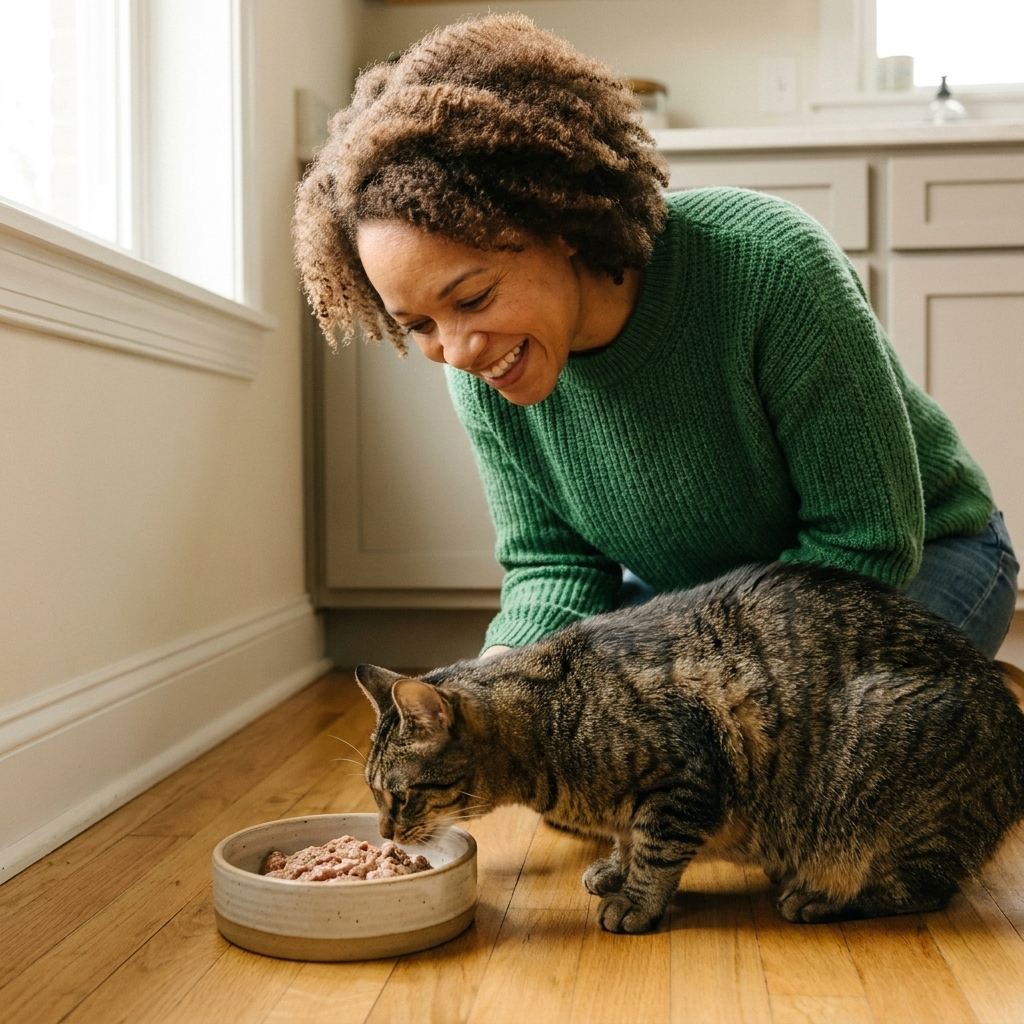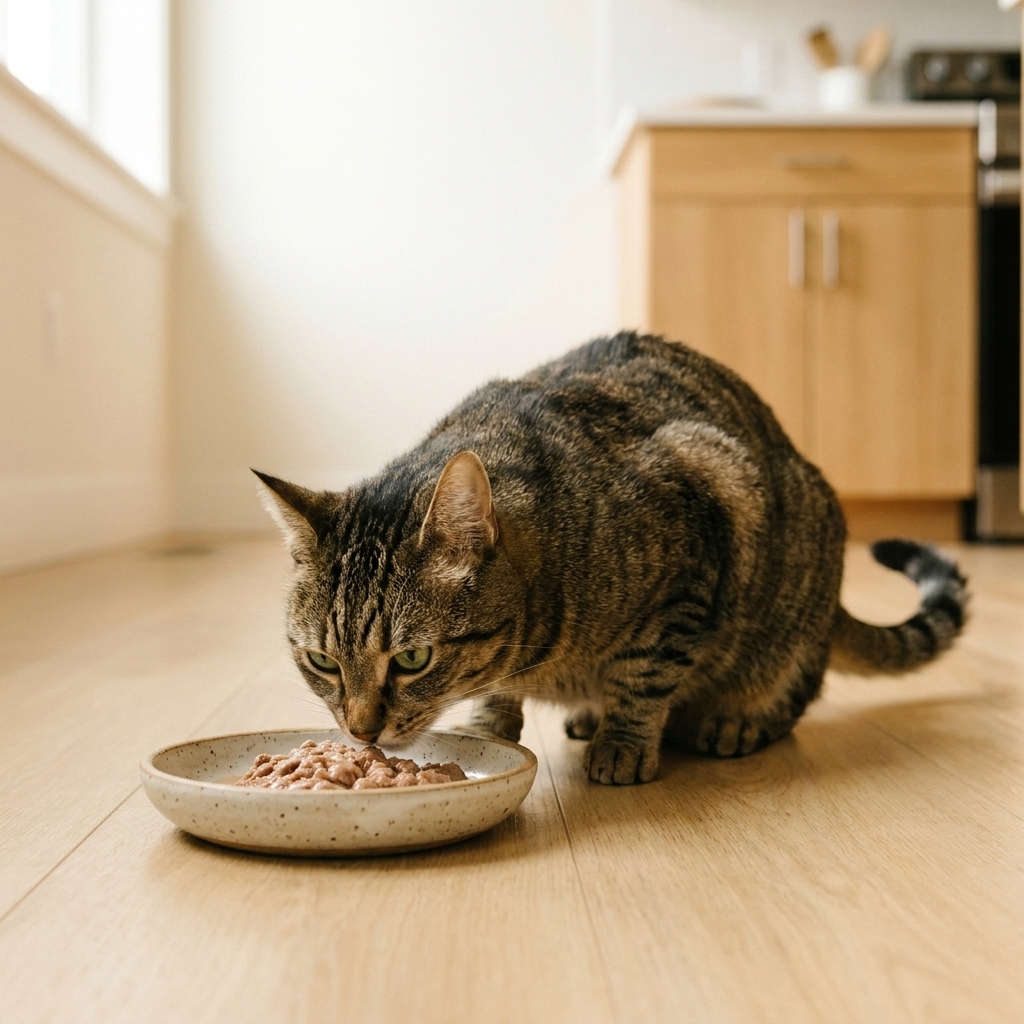
A judgment-free, step-by-step guide to feline weight loss: smart feeding changes, indoor exercise ideas, treat tips, and how to monitor progress without risk...
If you are reading this with a very offended cat staring you down from the couch, I get it. Feline weight loss can feel emotionally loaded. You love your cat, you want them happy, and food is one of the easiest ways to show that love. The good news is that helping an overweight indoor cat slim down does not have to mean constant begging, dramatic hunger strikes, or a miserable household.
It does mean a plan. Safe feline weight loss is about controlled calories, consistent routines, and tiny changes that add up. As a former vet tech, I will also say this clearly: the goal is not “skinny.” The goal is comfortable movement, easier breathing, less joint stress, and a longer, healthier life.
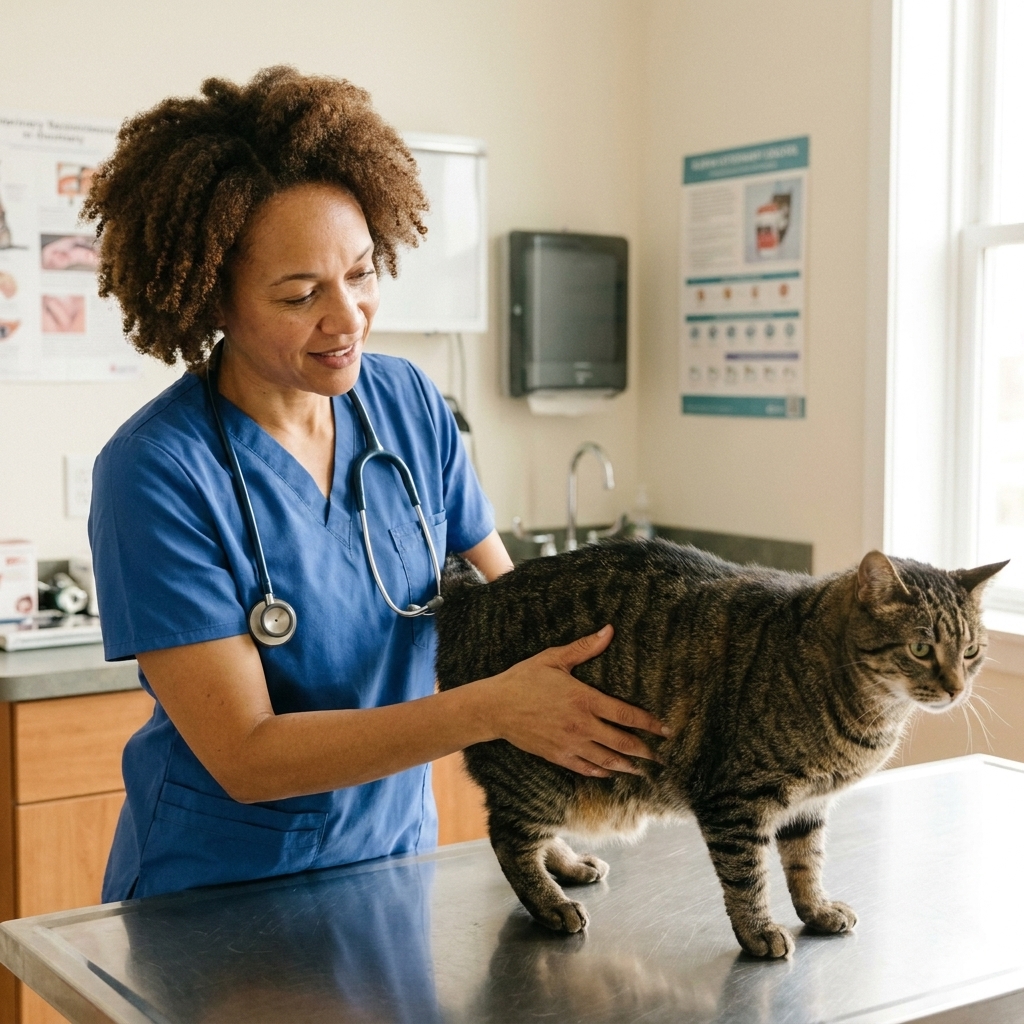
First, confirm it is truly weight
Before you cut calories, schedule a vet visit if your cat has not had one recently, especially if the weight gain was fast or your cat is middle-aged or senior. A few medical issues can contribute to weight changes and appetite shifts, including diabetes, arthritis-related inactivity, and some medications. True hypothyroidism is extremely uncommon in cats, but iatrogenic hypothyroidism can happen in some cats after treatment for hyperthyroidism, and your vet can rule out what applies to your cat.
Use a body condition score at home
A scale number alone can mislead, because cats come in different frames. Vets use a body condition score (BCS). You can do a quick version at home:
- Ribs: You should be able to feel ribs with light pressure, like running your fingers over the knuckles of your hand.
- Waist: From above, there should be a visible waist behind the ribs.
- Tuck: From the side, the belly should tuck up slightly, not hang low or swing.
If you cannot feel ribs without pressing firmly, or there is no waist at all, your cat likely has extra body fat and would benefit from a structured plan.
Why crash diets are dangerous
Cats are not small dogs, and they are definitely not tiny humans. When cats do not eat enough, they are at risk for a life-threatening liver condition called hepatic lipidosis (fatty liver disease). This can happen after a period of poor intake, especially in overweight cats.
That is why the safest approach is slow, steady loss, not dramatic restriction.
A safe rate of loss
In many cases, a reasonable target is about 0.5% to 1% of body weight per week. Some cats may do okay closer to 2% for short periods, but that upper end should be reserved for veterinary supervision and close monitoring. Faster is not better here.
Call your vet promptly if your cat refuses food for 12 to 24 hours (sooner if your cat is obese, diabetic, or has a history of hepatic lipidosis), eats much less than usual for more than a day, vomits repeatedly, or seems weak or hides more than normal during a weight loss plan.
Step 1: Set a real calorie budget
Portion control only works when you know what your cat actually needs. Most indoor cats need fewer calories than people assume, and “a little extra” adds up fast.
Ask your vet for a daily calorie goal
The most accurate way is to have your veterinarian calculate a weight loss calorie target based on your cat’s current weight, target weight, body condition, and health status. If your cat has diabetes, kidney disease, urinary issues, or is a senior with muscle loss, the plan may need special adjustments.
Read the label like a detective
This is where many people get stuck, so here is the simple version: look for kcal on the packaging.
- Wet food: calories are often listed as “kcal per can” or “kcal per 3 oz can.”
- Dry food: calories are often listed as “kcal per cup” (sometimes also as kcal/kg). If your vet gives you grams, you can weigh it out with a kitchen scale and skip the measuring-cup guesswork.
If the label is confusing, bring a photo of it to your vet. Many clinics will happily convert a calorie goal into a daily gram amount for you, which makes life easier.
Start with what you are currently feeding
For one week, measure everything your cat eats:
- All meals
- All treats
- Dental treats and lickable tubes
- Table scraps (even small bites)
- Food stolen from other pets
Write it down. This is not about guilt. It is about getting clear, so your next change is precise.
Step 2: Use a feeding schedule
If your cat has a full bowl available all day, weight loss is much harder. Many indoor cats graze out of habit or boredom. A schedule gives you control and usually reduces food anxiety once your cat learns the routine.
Schedules that work
- Two meals per day: simple and works well for many households.
- Three to four smaller meals: often better for cats who act like they are starving at all times.
- Timed feeder for dry food: great if you work outside the home or have multiple cats.
Aim for consistent meal times. Cats love predictability, even when they pretend they do not.
Transition tip for former free feeders
Do not go from unlimited access to strict meals overnight. Over 7 to 10 days, gradually remove the bowl between meals and consolidate the same daily amount into scheduled feedings. During this transition, do not reduce calories yet. Once the schedule is stable and your cat is calmly eating meals, start reducing calories according to your plan.

Step 3: Measure portions
This is the unglamorous secret behind almost every successful feline weight loss story: you must measure.
Use a kitchen scale when possible
Measuring cups are easy to overfill. A small difference in kibble can mean meaningful extra calories over time. For dry food, a digital kitchen scale is more accurate. For wet food, weighing portions can also help if you are splitting cans.
Count treats inside the daily calories
Treats are not “bonus” calories. They are calories. If you want treats (and I do not blame you), build them into the daily budget.
A helpful guideline: keep treats to 10% or less of daily calories, and for faster progress, even lower.
Healthier treat swaps
- Freeze-dried single-ingredient meat treats (check calories, they add up)
- A few pieces of your cat’s measured kibble used as treats
- A teaspoon of wet food or a small lick mat smear instead of a handful of snacks
Step 4: Pick the right food
Not all “weight management” foods are created equal. The best diet for feline weight loss supports satiety and muscle maintenance, while controlling calories.
What to look for
- High protein to support lean muscle mass
- Controlled fat to reduce calorie density
- Fiber (sometimes) to help some cats feel fuller
- Complete and balanced nutrition for your cat’s life stage
Your veterinarian may recommend a prescription weight loss diet for the most consistent results, especially for cats with significant obesity. These diets are designed to provide adequate nutrients even with calorie restriction.
Wet food vs dry food
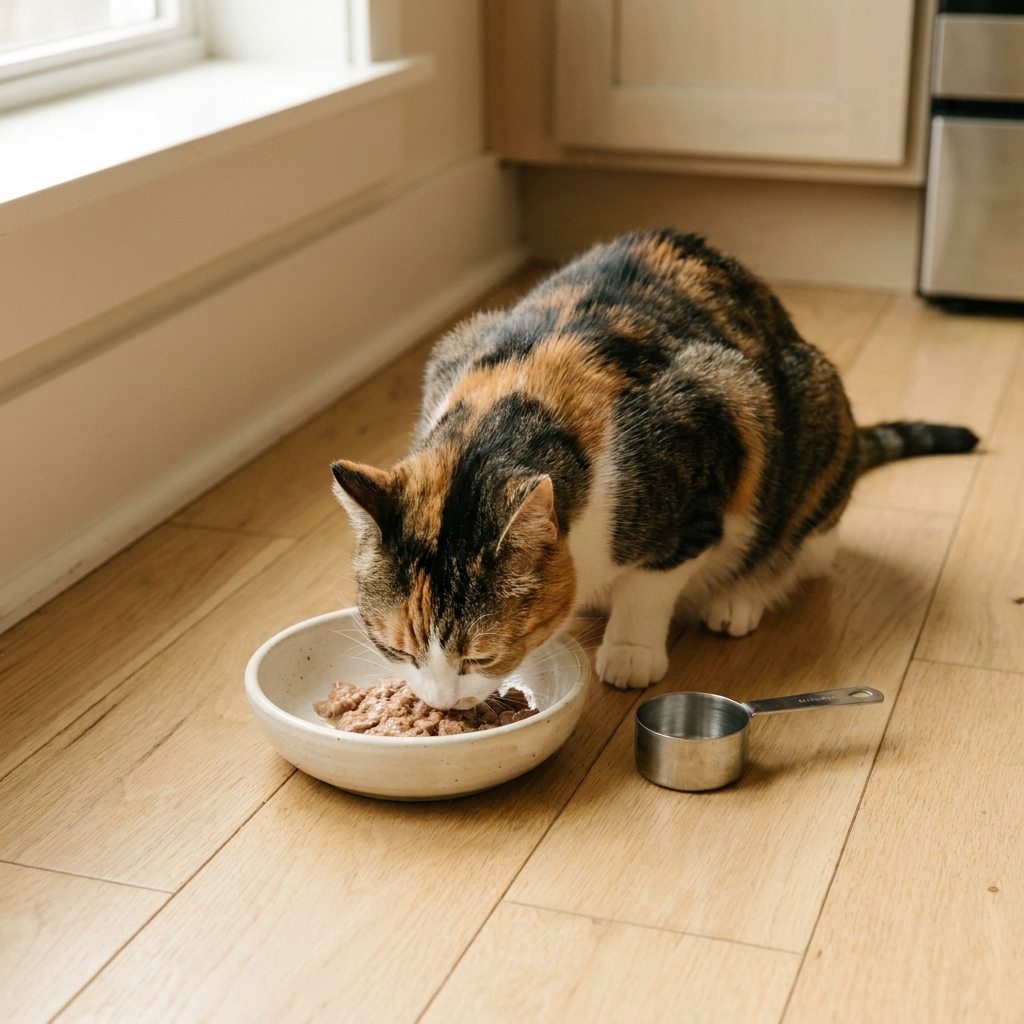
Many cats lose weight more easily with more wet food because it is often less calorie-dense by volume and adds moisture, which can increase meal satisfaction. That said, calorie density varies a lot by brand and recipe, so check the kcal on the label instead of assuming.
You can absolutely do weight loss with dry food, especially if your cat refuses wet. You just need tight measuring, slow adjustments, and preferably puzzle feeders to slow down eating.
Switch foods gradually
If you are changing diets, do it over several days (sometimes longer for sensitive cats) to reduce tummy upset. If your cat develops vomiting, diarrhea, or stops eating during a switch, pause and call your vet for advice.
Reduce begging with strategy
Begging is usually a mix of habit, learned behavior, and genuine food motivation. When we change portions, we need to change the environment too.
Use puzzle feeders and food games
Make meals last longer and turn calories into enrichment:
- Treat balls or rolling feeders for measured kibble
- Snuffle mats that are cat-safe and low-frustration
- Small bowls spaced around the house for “hunt” feeding
- Simple DIY: scatter measured kibble in several safe locations (not near litter boxes)
Split meals into mini meals
If your cat acts frantic between meals, splitting the same daily calories into 3 to 5 smaller servings can reduce the “empty bowl panic” without adding calories.
Build a new attention routine
Many cats beg because begging works. If your cat meows, you feed, and now the cat has trained you. Instead, try:
- Offer playtime or brushing at the usual begging hour
- Reward quiet behavior with attention first, then the scheduled meal
- Use an automatic feeder for one meal so your cat stops associating you with every calorie
Multi-cat households
If one cat needs to lose weight and the other does not, you are managing a tiny, furry heist operation.
Options that work
- Microchip feeders: the gold standard for preventing bowl swapping.
- Meal feeding in separate rooms: feed, supervise, pick up bowls after 15 to 20 minutes.
- Vertical separation: if one cat can jump and the other cannot, feed the lean cat on a counter-height surface only if it is safe and permitted in your home.
If your cats eat at wildly different speeds, the fast eater may need a slow feeder or puzzle feeder so the slower cat can finish without pressure.
Exercise for indoor cats
You cannot outrun a bad diet, and for cats, the diet is usually the biggest lever. But movement matters for joint health, mood, digestion, and preserving muscle during weight loss.
Daily play goals
Aim for two to three short play sessions per day, even if each one is just 5 minutes to start. Consistency beats intensity.
My favorite low-stress ways to increase activity
- Wand toy “hunt” routine: stalk, chase, pounce, then a small meal afterward
- Laser pointer done safely: always end by tossing a toy or treat your cat can physically catch
- Cat trees and window perches: encourage climbing and jumping in short bursts
- Toy rotation: put toys away and swap every few days so they feel “new” again

Track progress without panic
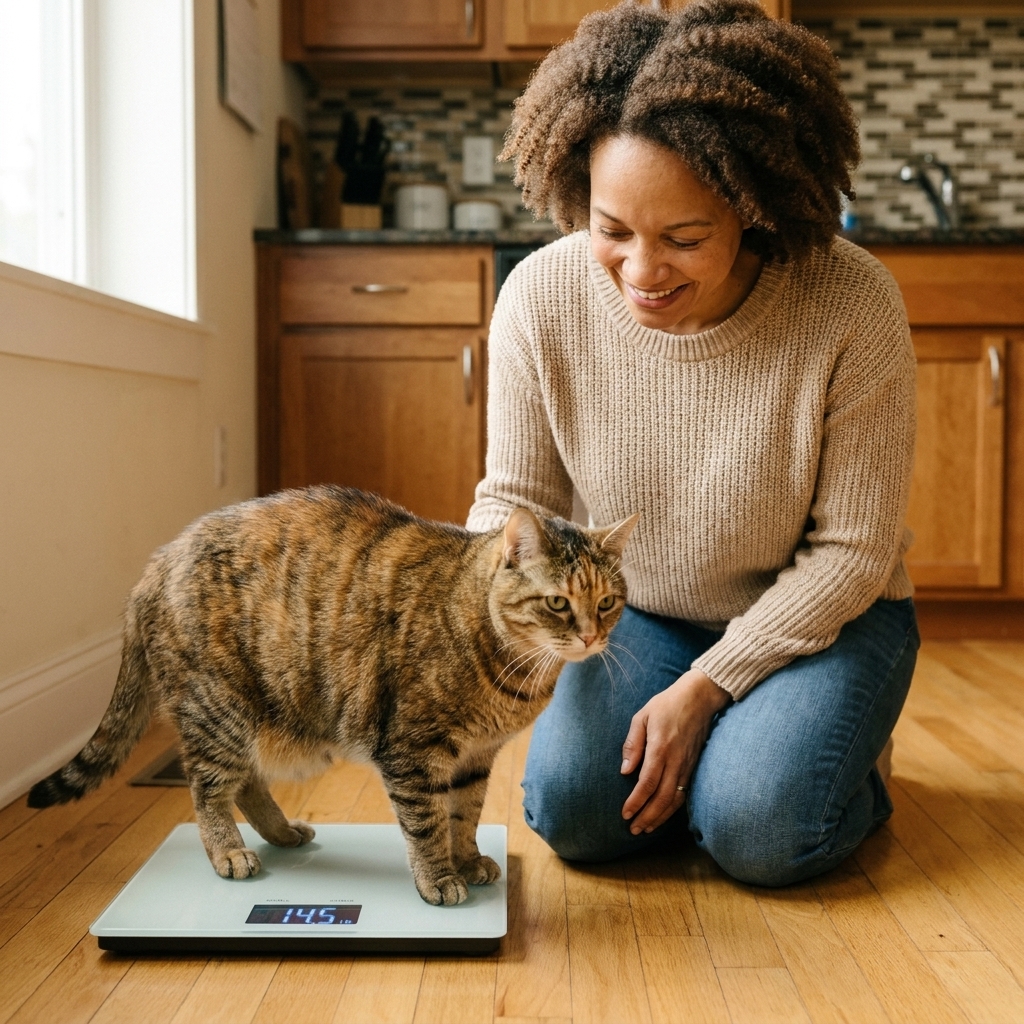
Weight loss is rarely linear. Your job is to watch the trend, not spiral over a single weigh-in.
Weigh-ins
- Frequency: every 2 weeks is often a sweet spot
- How: weigh yourself holding your cat, then subtract your weight alone, or use a baby scale if your cat tolerates it
- Same conditions: weigh around the same time of day for consistency
Also track body shape
Take a monthly top-down photo of your cat standing naturally. Many pet parents notice the waist reappearing in photos before the scale reflects big changes.
If your cat is losing weight but seems weak, less playful, or “bony” over the spine, talk to your veterinarian. We want fat loss, not muscle loss.
Common setbacks
“My cat is always hungry.”
First, confirm you are feeding the right amount with accurate measurements. Then try:
- More wet food or a diet designed for satiety
- Split meals into more frequent mini meals
- Add puzzle feeders so meals take longer
- Increase play and enrichment, since boredom can look like hunger
“My cat screams at 5 a.m.”
Set an automatic feeder to deliver a small early meal, or shift the largest meal later in the evening. Also, avoid reinforcing the screaming with instant breakfast. Hard at first, easier after a week or two.
“Nothing is happening.”
If there is no loss after 3 to 4 weeks, one of these is usually true:
- Calories are higher than you think (treats, extra scoops, another pet’s bowl)
- Portions are not measured precisely
- The calorie goal needs adjustment
- There is an underlying medical issue
Bring your logs to your vet. A small calorie reduction can make a big difference for cats.
Maintain the loss long term
The finish line is not the day your cat hits a healthier weight. The finish line is staying there while still enjoying life.
What maintenance looks like
- Keep measuring food for at least several months after goal weight
- Continue scheduled meals, not free feeding
- Weigh monthly so small gains do not become big ones
- Plan for life changes like moving, new pets, or a new job schedule, since stress can change eating patterns
Most cats need a slightly higher calorie allotment at maintenance than during active weight loss, but usually not as high as before. Your vet can help you adjust gradually.
When to call your vet now
Please do not try to DIY a strict plan without guidance if any of these apply:
- Your cat is very obese or has trouble grooming, jumping, or breathing normally
- Your cat has diabetes, kidney disease, urinary tract disease, heart disease, or pancreatitis history
- Your cat is a senior and has noticeable muscle loss
- Your cat is on medications that affect appetite or metabolism
- Your cat stops eating or is losing weight too quickly
A tailored plan can prevent complications and make the process less stressful for both of you.
FAQ
How long does it take for a cat to lose weight?
It depends on how much weight your cat needs to lose and how consistent the plan is. Many cats do best with slow loss over months, not weeks. Sustainable progress is safer and more likely to stick.
Can I just feed less of my current food?
Sometimes, yes, especially for mild weight gain. The risk is that significant calorie restriction with a regular maintenance diet can reduce essential nutrients. If your cat needs meaningful weight loss, a veterinary weight management diet is often a better tool.
Is it okay if my cat begs?
Begging is not an emergency, but refusal to eat is. A little complaining is normal during the transition. If your cat is frantic, vomiting, or stops eating, contact your vet and slow the changes down.
Should I try intermittent fasting for my cat?
I do not recommend long fasting windows for cats without veterinary direction. Cats do better with predictable, smaller meals, and fasting can increase risk in overweight cats.
A gentle reminder
In clinic, I met so many pet parents who felt ashamed that their cat gained weight. I have also met a lot of cats who gained weight because indoor life is comfortable, food is rewarding, and modern calories are dense. This is common, and it is fixable.
Pick two changes to start: measure portions and switch to scheduled meals. Once those are steady, refine the calories, add enrichment, and keep checking in with your vet. Your cat does not need perfection. They need consistency, and they need you.